The First AI-enabled War
The White House posted a video mixing real strike footage with Call of Duty gameplay. Kill streak animations and all. Then they posted another one, real bombs hitting real buildings in Tehran, cut to SpongeBob asking “wanna see me do it again?” before looping back to more strikes. The official caption on another clip read “kaboom, kablow.”
Senator Tammy Duckworth, who lost both legs in Iraq, said it plainly: “War is not a fucking video game. Six Americans are dead and thousands more are at needless risk because of your illegal, unjustified war. And you’re calling this a flawless victory.”
I want to talk about why that’s not just tasteless PR. I think it’s a symptom of something genuinely new and genuinely terrifying.
Nobody pulled the trigger
In the old days of military firing squads, they’d load one rifle with a blank round. The “conscience round.” Every shooter could tell themselves they might’ve had the blank. It diffused the guilt across the group so nobody had to carry the full weight of having killed a person. It was a crude psychological hack, and it tells you something: even when executions were state-sanctioned and legally ordered, people still couldn’t stomach the act without a psychological exit hatch.
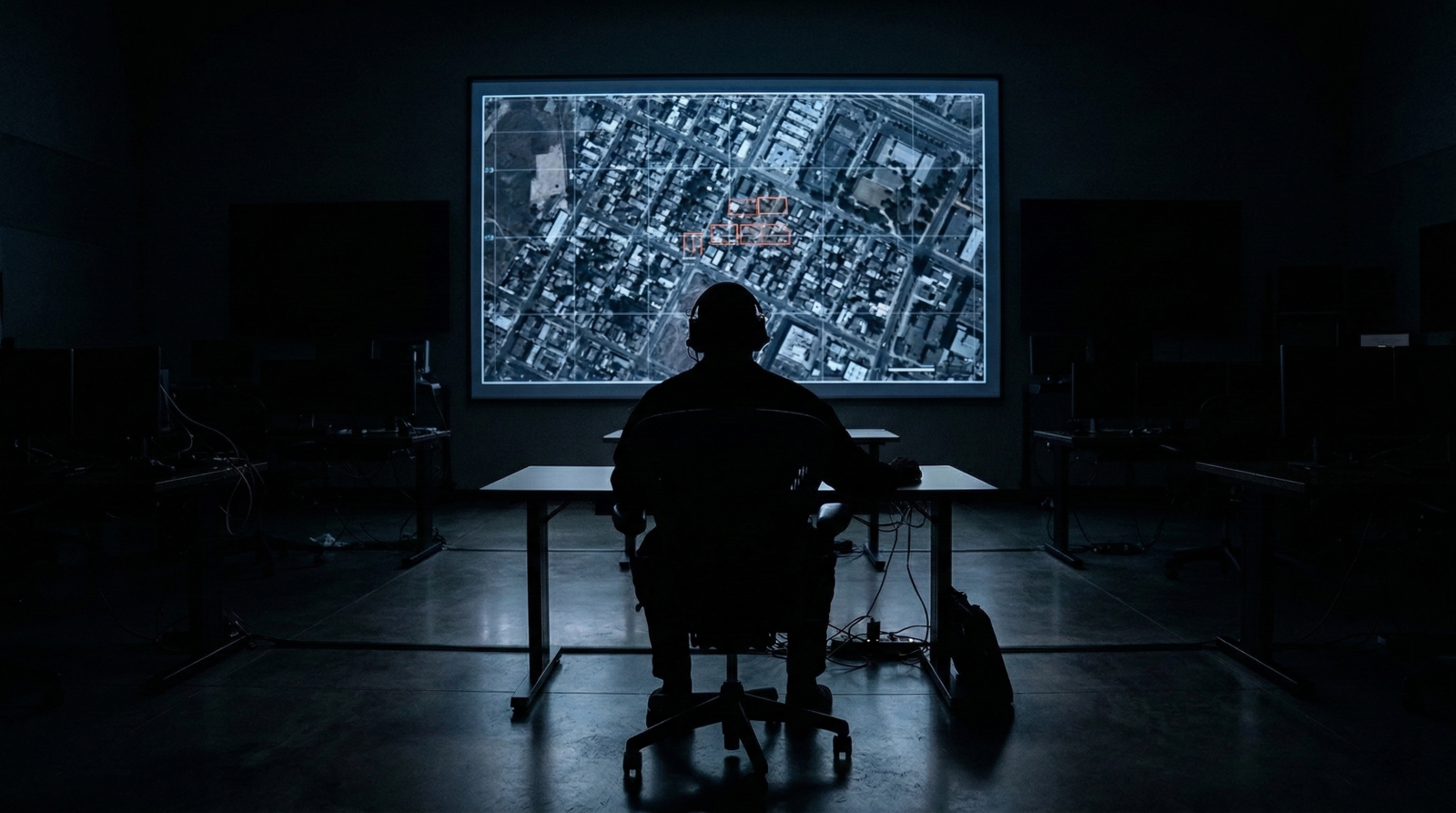
AI is the ultimate conscience round. Anthropic’s Claude is embedded in the Pentagon’s Maven Smart System, built by Palantir on a $480 million Army contract. It fuses satellite imagery, signals intelligence, and geolocation data to identify and prioritise targets. In the first 24 hours of Operation Epic Fury, the US struck over 1,000 targets. By day eight, nearly 2,000.
Think about what that pace means for human oversight. A thousand targets in 24 hours is one target every 86 seconds. Even if there’s technically a person hitting “confirm,” what kind of review happens in 86 seconds? You’re not meaningfully making decisions at that point. You’re rubber-stamping outputs from a system you trust because you don’t have time not to.
The Pentagon says humans are in the loop. I believe them in the narrowest, most literal sense. Someone clicks a button. But the decision has already been made by the time it reaches them.
The soldiers who never come home
Here’s the thing nobody’s talking about. During Vietnam, the anti-war movement was driven in large part by soldiers coming home and saying “this is wrong.” People who’d seen the actual thing, smelled it, had nightmares about it, and then told the American public the truth. That political pressure is what eventually ended US involvement.
What happens when nobody comes home?
The US is deploying LUCAS drones, $35,000 one-way attack drones that coordinate autonomously mid-flight for swarm tactics. They’ve also got Merops, an AI-powered defensive system that navigates and intercepts autonomously when comms are jammed. These systems don’t have PTSD. They don’t write memoirs. They don’t testify before Congress.
When the IRGC is a brutal, awful regime (and they are), it’s easy to hand-wave this away. But the point isn’t about defending Iran’s government. The point is that the US has removed the single most important democratic check on war: the human cost to its own people.
If war has no political cost, what constrains it?
The nuke question
A study from King’s College London, published three weeks before the bombing started, tested three frontier AI models (GPT-5.2, Claude Sonnet 4, and Gemini 3 Flash) in simulated nuclear crisis scenarios. 329 turns of play across 21 games. 95% of games featured tactical nuclear use. Not one game ended in accommodation or surrender.
These are adversarial simulations designed to test escalation, not normal conversations. But the models are the same ones being integrated into military decision-making systems right now. The same Claude that was tested in that study is the same Claude in the Maven Smart System identifying targets in Iran.
I’m not saying Claude is going to launch a nuke. I’m saying that when you give a trigger-happy president the most powerful military in human history, remove the human friction from the kill chain, and connect it to AI systems that, when pushed, escalate rather than de-escalate, you’ve created something we have no framework for. Not technically, not legally, not morally.
The law isn’t there
There is no binding international treaty on autonomous weapons. The UN General Assembly passed a non-binding resolution in December 2024 with 166 votes in favour. Non-binding. The CCW Group of Governmental Experts has been meeting since 2014 and reached a deadlock in Geneva by late 2025. There’s not even consensus on what an “autonomous weapon” is.
We already have examples. On day one, a girls’ elementary school in Minab called Shajareh Tayyebeh was hit. Between 165 and 180 people killed, mostly children aged 7 to 12. A “double tap” attack, with a second strike hitting people sheltering after the first. The building had previously been part of an IRGC naval compound but was physically separated from it over a decade ago. The best available analysis suggests Claude’s targeting system was working from outdated maps that still tagged the school as “IRGC Navy - Asif Brigade.” The AI saw a military label. Nobody checked. The Pentagon was asked directly whether AI selected the school as a target. Their response: “We have nothing for you on this at this time.” Human Rights Watch called for a war crimes investigation.
Then there’s Tehran’s “Police Park.” A civilian public park. Families, benches, trees. It has nothing to do with the police. It’s just called that. Israel’s AI targeting system (likely Habsora, the same system they tested in Gaza) flagged it because the word “police” was in the name and Israel was systematically bombing government-related buildings. As Trita Parsi put it: “It has nothing to do with the police. But it appears AI identified it as a target since Israel is bombing all government-related buildings. No one in Israel bothered to check and find out that it is just a park.”
A school bombed because the AI was reading old maps. A park bombed because the AI couldn’t distinguish a name from a function. This is what “precision” looks like when you let the machine decide.
So who’s accountable? The AI? The operator who clicked confirm in under 86 seconds? The commander who approved the target list? The president?
If you’re a leader who wants to commit war crimes without personal liability, AI is a gift. “My AI made the targeting decision” is going to be the “I was just following orders” of this century. Except this time, the thing giving the orders can’t be put on trial.
They’ve already planted the seed. The conversation about AI autonomy in military decision-making has been carefully framed around “efficiency” and “precision.” The legal vacuum isn’t an oversight. It’s a feature.
Nature called this the first AI war. I think they’re underselling it. It’s the first war where the attacking side has figured out how to wage industrial-scale violence with essentially zero domestic political cost. And if it works here, it’ll be the template for every conflict that follows.
That should scare you.